|
Grigor GURZADYAN (1922-2014)
|

|
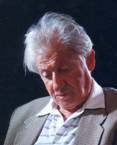
Grigor Gurzadyan is one of the distinguished persons of Armenian astronomy whose courageous ideas and interesting scientific results always delighted the scientists. He is known as one of the founders of space astronomy. Gurzadyan’s work is wide and extensive; besides astronomy he is known as a talented artist, as well as an author of numerous literary works.
Grigor Aram Gurzadyan was born on October 15, 1922 in Baghdad (Iraq) to a family of parents fled from Western Armenia in 1915. In 1944 he graduated from the Hydrotechnical and Constructional Departments of Yerevan Polytechnic Institute. The same year he became the post-graduate of academician Viktor Ambartsumian, and in 1948 at the age of 26 he defended his Candidate thesis on the topic “The Radiation Balance of Interstellar Gas Matter” in Moscow State University. In essence Gurzadyan was one of the main scientists of the founding team of the Byurakan Astrophysical Observatory. In 1955 (at the age of 33) he defended his Doctorate thesis. In 1950-1966 Gurzadyan was the Head of the Department of Physics of Stars and Nebulae of the Byurakan Observatory, in 1967-1973 he headed the branch of space researches, in 1973-1978 he headed Garni Astronomy Laboratory, in 1978-1992 he was the Head of Extra-atmospheric Astronomy Laboratory of the Byurakan Observatory, in 1992-2004 he was the Head of Garni Space Astronomy Institute. Since 1979 he was the Head of the Chair of Space Instrument-Making of Yerevan Polytechnic Institute as well. For decades he lectured theoretical astrophysics at Yerevan State University and precise mechanics at Yerevan Polytechnic Institute, in 1962 he was awarded a professorship, in 1965 he was elected a corresponding member of Armenian SSR Academy of Sciences, in 1986 a full member.
Gurzadyan’s works refer to the problems of radiation equilibrium of interstellar space, the morphological and kinematical investigations of stellar associations, diffuse and planetary nebulae, space instrument-making. He worked out the theory of formation of double-envelope nebulae, investigated the meaning of the magnetic field in formation of planetary nebulae forms, worked out a theory of star flares based on non-thermal phenomena occurring in them. Gurzadyan created a number of scientific devices and optical systems as well. The formation of automatic operation method, of the principle of optical system work of Orion Space Observatory is connected with his name. In 1990s he worked out the theories of common chromospheres (roundchromes) of close binary stars and of evolution of binary globular clusters.
As it was mentioned, Gurzadyan was among the founders of space astronomy. In 1960s using ballistic rockets R-5, he directed the UV and X-ray observations of the Sun and stars (the first launch was on February 15, 1961 from Kapustin-Yar base). His paper “A Powerful X-ray Flare on the Sun”, published in communications of Armenian SSR Academy of Sciences in 1966 is among the earliest papers on space astronomy. Then Gurzadyan moved to design space orbital observatories; Orions were the most famous ones. In April, 1971 the first space station Salyut 1 carried Orion 1 onto the orbit, the first space telescope with an objective prism. But the highlight was Orion 2, which was operated onboard the spacecraft Soyuz 13 in December, 1973. Spectra of thousands of stars to 13th stellar magnitude, the first satellite UV spectrogram of a planetary nebula were obtained revealing spectral lines of aluminum and titanium – elements not previously observed in planetary nebulae, two-photon emission from nebula was directed for the first time. For comparison, the US Skylab’s UV telescope, which was on the orbit at the same time, could only observe stars down to 7.5th magnitude. The obtained results were published in the most important astronomical journals, including 3 articles in the high-ranked journal “Nature”.
Gurzadyan authored the most significant theoretical papers devoted to planetary nebulae, interstellar matter and flare stars. He published more than 200 scientific papers and a number of monographs: “Radioastrophysics” (1956, in Russian), “Planetary Nebulae” (“Nauka”, 1962, in Russian and “Gordon and Breach”, 1970, in English), “Flare Stars” (“Nauka”, 1973, in Russian and “Pergamon”, 1980, in English), “Stellar Chromospheres” (“Nauka”, 1984, in Russian), “Physics and Dynamics of Planetary Nebulae” (“Nauka”, 1988, in Russian and “Springer”, 1997, in English), “Theory of Interplanetary Flights” (“Gordon and Breach”, 1996, in English) and “Space Dynamics” (“Francis and Taylor”, 2002, in English). Numerous paintings and literary works belong to Gurzadyan’s creative heritage.
Grigor Gurzadyan is a member of International Astronomical Union (1950) and an Honored Scientist of the Armenian SSR (1975). He was awarded the order “Sign of Honor”.