|
Beniamin Markarian (1913-1985) |

|
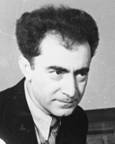
Very few astronomers with their contribution in the observational astronomy can be compared with Beniamin Markarian. After the distinguished scientist Viktor Ambartsumian he is very likely the greatest person of Armenian astronomy. His survey and Markarian galaxies are known to each astronomer and not only to astronomers. So far many astronomers and world observatories work on investigations of Markarian galaxies.
Beniamin Y. Markarian was born on November 29, 1913 (according to the new style, on December 12) in Shulaver (at present Shahumyan) of the district of Marnueli of the Soviet Republic of Georgia. In 1933 he entered and in 1938 with a diploma of excellence graduated from the faculty of physics-mathematics of Yerevan State University. In 1938-1941 he worked as a senior lecturer of higher mathematics at Yerevan Pedagogical Institute. In 1939 B. Markarian entered the post-graduate fellowship of the Armenian branch of the USSR Academy of Sciences in the sphere of astrophysics and went to Leningrad University. But his studies were interrupted by World War II and in 1941 after returning to Armenia he was called up to the Army. After the Army he was a senior researcher at the Yerevan Astronomical Observatory (1942-1946). In May 1944 under the academician V. Ambartsumian’s supervision Markarian successfully defended his candidate thesis on a subject “The fluctuations observed in the visible distribution of stars and the cosmic absorption”. Since 1946 (since the day of foundation) he was a senior researcher at the Byurakan Astrophysical Observatory, in fact being one of its founders. Markarian actively participated in the selection of the site of the new observatory, which needed serious work for further effective observations. Markarian personally mounted and put almost all telescopes of the Byurakan Observatory into operation (except the last telescope of 2.6 m), thus making basis for the development of observational astronomy in Armenia.
In 1953-1956 Markarian worked as a deputy director on science of the Byurakan Observatory. He was appointed as the Head of the Department of Investigation of Stars from 1957 to 1962, then of the Department of Galaxies from 1962 to 1985. In 1943-1956 he also worked as a lecturer of astronomy at Yerevan State University. He was elected as a corresponding member of the Academy of Sciences of the Armenian SSR (1965), as a full member of the Academy of Sciences of the Armenian SSR (1971). He was awarded a title of Honored Scientist of the Armenian SSR (1961). Markarian was elected as a member of Astronomical Council of the USSR Academy of Sciences (1964), he a member of the International Astronomical Union (IAU, 1955), he was elected as a Vice-President of the IAU Commission on Galaxies (1973-1976) and its President (1976-1979).
B. Markarian’s scientific works refer to the physics of stars, stellar clusters and galaxies. He took part in working out of the theory of fluctuations observed in the distribution of stars taking into consideration the interstellar absorption. On the basis of observational data he has confirmed that the stellar associations expand. Markarian has worked out a new classification of stellar clusters and in 1952 he has compiled and published “An atlas of different types of stellar clusters”. In 1963 he revealed 73 galaxies with an unusual color to their spectral class. He has worked out a special method (for selecting galaxies with ultra-violet excess) on the basis of which 1965-1980 a spectral sky survey was obtained in the Byurakan Observatory. He has revealed 1500 objects of special class which are called by his name (Markarian galaxies or galaxies with ultra-violet excess). Since 1968 with the help of large telescopes of the USSR and the USA, spectral observations of these galaxies were carried out and a great number of active galaxies were discovered among them essentially changing our understanding concerning the population of the Universe and the activity of galaxies. Later from 1974 to 1991 again on Markarian’s initiative the Second Byurakan Survey was conducted in which a great number of quasars and other active galactic nuclei were revealed. The catalog of Markarian galaxies was published after his death by his colleagues in the USA in 1986 and in the USSR in 1989.
B. Markarian has published more than 100 scientific papers. He is a USSR State Prize winner (1950). He was awarded the orders “Sign of Honor” (1955) and “Peoples’ Friendship” (1983), as well as a number of medals and diplomas of the Presidiums of the Academies of Sciences of the USSR and the Armenian SSR and of the Supreme Council of the Armenian SSR.
Beniamin Markarian passed away on September 29, 1985 in Yerevan. Till the end of his life, in spite of his poor health, he actively worked doing the main job of his scientific life; the Byurakan Surveys.